
Rebuilding Organizational Clarity at a 350-Employee CRO in 40 Days
The engagement began without a predefined problem to solve. Broad access was granted across teams, systems, and leadership to observe how decisions, information, and execution actually flowed—then translate findings into executive-ready clarity and immediate operational improvements.
Rapid growth created systemic execution strain—leaders could sense friction, but couldn't see the root causes.
The organization faced unclear ownership across departments, redundant initiatives competing for the same resources, inconsistent handoffs between BD, PM, Ops, and Marketing, fragmented data systems, and merger-era documentation that never integrated into production workflows.
Leadership needed fast, accurate intelligence to understand how work actually moved through the organization—without guessing and without waiting for a long consulting cycle.
An open diagnostic: trust-building, system mapping, and executive synthesis—without a scoped hypothesis.
Instead of starting with a narrow project definition, the engagement started with visibility. Trust was built quickly, the end-to-end operational system was mapped, and issues with no clear owner were pulled forward. Findings were translated into implementation-ready decisions.
Mapping accountability drift across the workflow lifecycle.
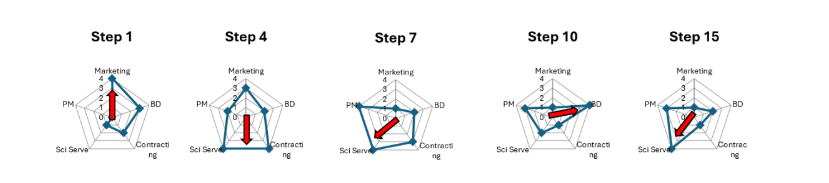
RACI Workflow Visualization: Leveraged systematic process mapping to advise executive leadership on fundamental procedural gaps and accountability frictions across eight departments, quantifying a 4.7× failure amplification pattern that informed structural recommendations.
Multiple "small" failures were compounding into a measurable execution risk pattern.
The core issue was not effort or talent. It was how decisions, definitions, ownership, and information moved across boundaries. Where ownership was unclear or systems were fragmented, handoffs degraded and duplicated work emerged.
Mapped the system, quantified risk, resolved high-leverage issues, and delivered executive-ready direction.
Materials designed for leadership decisions and fast adoption.
Organizational clarity restored—without forcing a new bureaucracy.
"Jacob came in to assess cross-functional workflows. Within two weeks, he was using our own data to surface risks and bring clarity to processes we hadn't examined closely. He built trust quickly and focused on internal realities—not external frameworks. I'd recommend him to companies growing quickly or needing analytical and operational support."
— Senior Director